
Viola Frymann and the Medicine of Beginning
Some physicians devote their lives to treating disease.
Others devote their lives to protecting development.
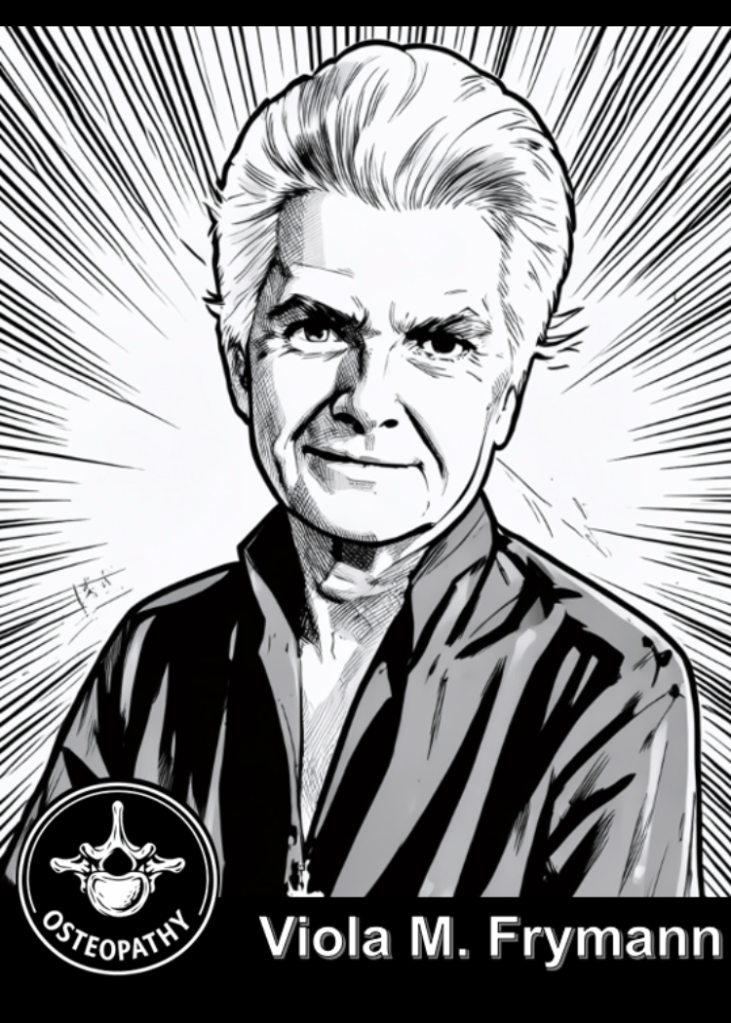
Viola M. Frymann, DO (1921–2016) belonged to the latter. Born in Nottingham, England, and later practicing primarily in California, Frymann became one of the most influential figures in pediatric cranial osteopathy and one of the most important stewards of osteopathic principles in the modern era. [legacy.com], [the-promise.org]
Her work was gentle.
Her stance was firm.
Her focus was unwavering: the earliest expressions of health and imbalance in children.
In doing so, she offered insights that extend far beyond pediatrics—into how trauma forms, how chronic pain takes root, and how early nervous‑system dysregulation shapes suffering across a lifetime.
From Loss to Lifelong Inquiry
Frymann’s path into cranial osteopathy was shaped by personal tragedy. After the death of her first child shortly after birth, she encountered the teachings of William Garner Sutherland, DO, founder of osteopathy in the cranial field. Sutherland’s work on the relationship between birth trauma, cranial mechanics, and vagal nerve function resonated deeply with her lived experience. [legacy.com]
She trained directly with Sutherland and became one of the most skilled clinicians and teachers of the cranial concept. What distinguished Frymann was not mere technical mastery, but her insistence that structure, physiology, and human development were inseparable—and that the effects of early disturbances reverberate silently over time.
This supports the ideas we explore in this blog: chronic pain, trauma, and addiction are not isolated phenomena, but the late echoes of unresolved dysregulation.
Pediatric Osteopathy: Prevention, Not Correction
Frymann did not view infants as “small adults.” She viewed them as organisms in rapid organization, exquisitely sensitive to mechanical strain, autonomic imbalance, and relational disruption. Birth, while often celebrated as benign, was understood by Frymann as a biomechanical and neurological event capable of imprinting the system for years to come.
Through decades of clinical work, she demonstrated that cranial osteopathy could influence feeding difficulties, colic, respiratory issues, developmental delays, postural asymmetries, and neurological symptoms—often with minimal force and maximal restraint. [osteomag.ca], [actascientific.com]
This was not mystical medicine. It was an argument for early regulation—for catching trauma before it became identity, pathology, or coping behavior.
A Global Teacher, a Reluctant Author
Frymann published relatively little compared to her influence, preferring direct teaching and hands‑on transmission. She traveled extensively, bringing osteopathic principles to Europe, Asia, Australia, and beyond, often being among the first osteopathic physicians to teach in new international settings. [legacy.com]
Her writings were later collected in:
The Collected Papers of Viola M. Frymann, DO: Legacy of Osteopathy to Children (1998), edited by Hollis H. King, DO, PhD, and published by the American Academy of Osteopathy. This volume spans clinical observation, philosophy, research considerations, and appeals to the profession to remain rooted in principle rather than popularity. [catalog.nlm.nih.gov], [books.google.com]
Taken together, these papers reveal Frymann as a scientist, philosopher, clinician, and advocate for children to reach—not merely survive—their potential.
Institutions and Stewardship
Beyond the clinic, Frymann played a critical role in preserving osteopathy itself. She helped restore osteopathic licensure in California in the 1970s and was instrumental in founding the College of Osteopathic Medicine of the Pacific (now Western University of Health Sciences). [news.westernu.edu]
She later founded the Osteopathic Center for Children in San Diego, and Osteopathy’s Promise to Children, organizations dedicated to pediatric care, research, and education grounded in traditional osteopathic principles. [osteopathi…center.org], [the-promise.org]
Her work ensured that osteopathy did not lose its moral center while modernizing.
Why Frymann Matters for Pain, Trauma, and Addiction
Frymann taught us something essential:
Dysregulation begins early.
Often before language.
Often before memory.
When we encounter chronic pain syndromes, trauma patterns, and addiction in adults, we are frequently witnessing the downstream effects of early autonomic imbalance—systems that adapted brilliantly to stress, but never learned to return to baseline.
Frymann’s pediatric focus offers a mirror to adult medicine. It asks us not just to treat symptoms, but to gently inquire:
Where did regulation fail?
Where did protection become permanent?
What would it take for the system to feel safe again?
These questions align seamlessly with osteopathic manipulative medicine, somatic therapies, and even psychedelic‑assisted healing—modalities that aim not to suppress experience, but to reorganize it.
Closing Reflection
Viola Frymann worked at the beginning of life.
But her medicine reaches far into adulthood.
She reminds us that healing is not about force, persuasion, or override.
It is about listening—early, precisely, and with humility.
When we place our hands on the body, we are not correcting a machine.
We are meeting a story in motion.
And sometimes, if we are careful enough,
we can help the story change.
Further Reading and Study
- Frymann, V.M. The Collected Papers of Viola M. Frymann, DO: Legacy of Osteopathy to Children. American Academy of Osteopathy, 1998. [catalog.nlm.nih.gov]
- Osteopathic Cranial Academy. “The Trauma of Birth,” The Cranial Letter, 2019. [cranialacademy.org]
- Bonomi S, Filisetti M. The Value of Osteopathy for Children: The Contribution of Viola Frymann. Acta Scientific Paediatrics, 2020. [actascientific.com]
- Osteopathic Center for Children – History and Mission. [osteopathi…center.org]

