
Robert Fulford and the House on the Ocean
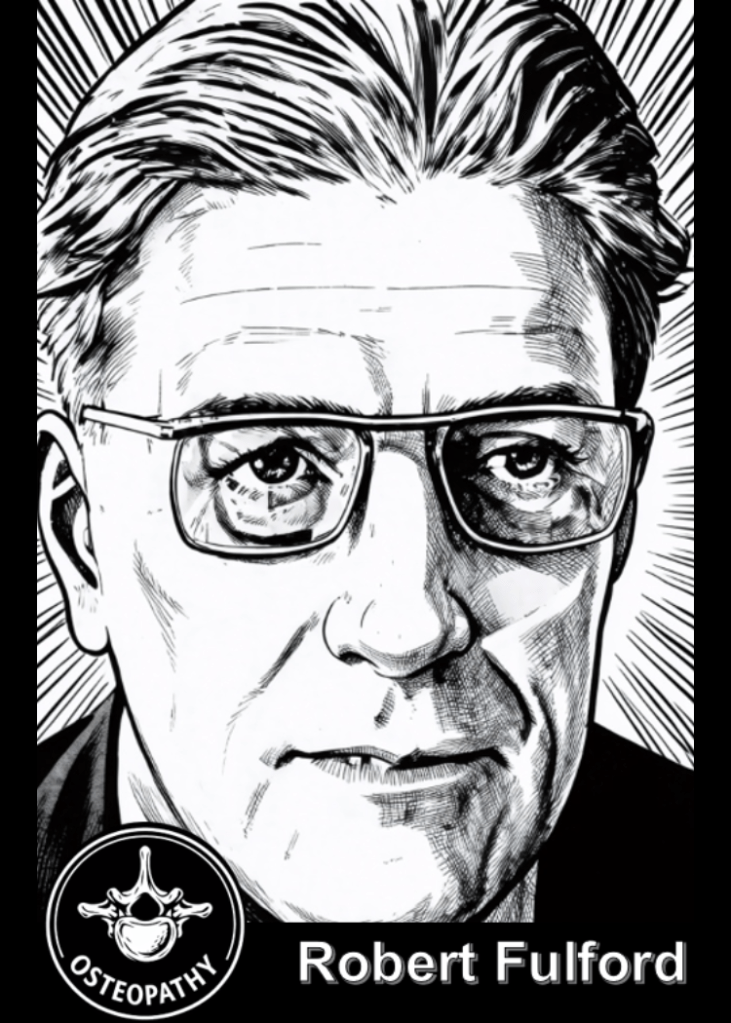
Robert C. Fulford, DO (1905–1998), often explained osteopathy using a deceptively simple image. He asked us to imagine the human body not as a structure fixed to solid ground, but as a house built on the ocean.
This was not poetry for its own sake. It was Fulford’s way of teaching how structure, motion, breath, and adaptability determine health—and why chronic pain, trauma, and addiction should be understood less as failures of repair and more as failures of adaptation.
The Metaphor Revisited
In Fulford’s telling, the ocean represents life itself: breath, fluid motion, inherent vitality, the continuous forces that move through all living systems. The ocean cannot be stopped. Waves will come whether we consent to them or not.
The house represents the body’s structure—bones, fascia, membranes, tissues. The foundation and pilings are the core organizing patterns that allow the structure to stand: cranial relationships, spinal balance, diaphragms, and fascial lines. The waves are both external and internal stressors—injury, illness, emotion, trauma, social strain, time.
The goal is not to eliminate the waves. The goal is to ensure the house can move with them.
What Fulford Was Teaching
If a house on the ocean is well‑built, aligned, and flexible, it responds to the movement beneath it. The structure sways. Energy dissipates. Nothing breaks.
But if the foundation is rigid, misaligned, or compromised, even modest waves generate strain. Stress concentrates instead of dispersing. Over time, cracks appear—not because the waves are abnormal, but because the structure cannot adapt.
This is how Fulford understood chronic illness. Pathology does not begin when stress appears. It begins when motion is lost.
Motion as the Measure of Health
Fulford emphasized that health depends on motion—especially respiratory motion, fluid motion, and cranial motion. When these rhythms are free, the system remains buoyant. When they are restricted, the system takes on water.
This is why Fulford could say, without irony:
“Health is a state of resonance.”
Resonance, for him, meant coherence across systems—structure responding appropriately to life force, breath synchronizing tissues, fluids adapting to demand. When resonance is present, the house floats well, no matter the weather.
Chronic Pain as Structural Rigidity
Seen through this lens, chronic pain is not simply a damaged plank. It is a house that has become too rigid to move with the sea.
Nervous systems under persistent threat narrow their range. Breath shortens. Fascial tone increases. Fluid motion slows. The structure may appear intact on imaging, yet functionally it can no longer dissipate stress.
Pain becomes chronic not because the waves never stop, but because adaptability has been lost.
Trauma and Loss of Adaptation
Trauma accelerates rigidity. In the presence of overwhelming stress, the system prioritizes survival over flexibility. This is adaptive—temporarily.
But when safety is never restored, protective patterns harden into default posture, tone, and perception. The house stiffens. The same waves now do more damage.
Fulford’s metaphor anticipates modern trauma science with uncanny accuracy. Trauma is not the storm. Trauma is what happens when the structure cannot move with the storm anymore.
Addiction as Temporary Buoyancy
From this perspective, addiction is often an attempt to restore buoyancy artificially. Substances, behaviors, rituals—each may momentarily increase resonance, quiet autonomic imbalance, or soften rigidity.
They do not repair the house.
They keep it afloat—briefly.
This reframing dissolves moral judgment. What remains is a system seeking regulation by whatever means it can access.
Osteopathy’s Role
Fulford believed osteopathic care was uniquely positioned to help because it does not fight the ocean. It works with the relationship between structure and motion. Treatment restores balanced movement so the house can once again respond harmoniously to life.
Gentle cranial work, attention to breath, fascia, and fluid rhythms—all serve the same purpose: restoring adaptability.
This is why Fulford’s thinking integrates naturally with breathwork, somatic therapy, and even psychedelic integration when practiced responsibly. Each seeks not dominance over the body, but renewed resonance within it.
Closing Reflection
The house on the ocean will never be still.
The waves will not stop.
Health is not rigidity.
Health is responsiveness.
Fulford did not ask whether the structure was strong enough to resist life. He asked whether it was free enough to move with it.
When motion returns,
when resonance is restored,
the house remembers how to stand.
And the waterline recedes.
Further Reading
- Fulford, R.C. Dr. Fulford’s Touch of Life. 1996.
- Fulford, R.C. Are We On the Path? The Collected Works of Robert C. Fulford, DO, FCA. 2003.
- Brooks, R.E. Three Great Teachers of Osteopathy: Lessons We Learned from Drs. Becker, Fulford, and Wales. 2023.

