
Upper Crossed Syndrome: How Stress Teaches the Body to Hold Itself
When we talk about Upper Crossed Syndrome (UCS), it is tempting to reduce it to ergonomics: screens too low, chairs too soft, shoulders too rounded. But for many people with chronic pain, trauma, or addiction histories, posture is not simply a habit—it is a learned physiological response.
Upper Crossed Syndrome sits at the intersection of body mechanics and subconscious stress. It shows us how tension becomes form. In a previous post, ergonomics was the focus, but I hope to take it further this time around.
Posture as a Learned Response
Humans do not hold themselves randomly. Posture reflects how the nervous system predicts the world.
A forward head, elevated shoulders, and a collapsed upper chest—hallmarks of UCS—narrow visual and airway fields, stabilize the neck, and brace the upper body. These changes are efficient when vigilance is required. Over time, they become automatic.
From a somatic perspective, posture is not chosen consciously. It is shaped by experiences that the nervous system encodes as “stay ready.” As Peter Levine describes in Waking the Tiger, unresolved stress and trauma do not disappear; they reorganize physiology.
Upper Crossed Syndrome can be understood as one such reorganization.
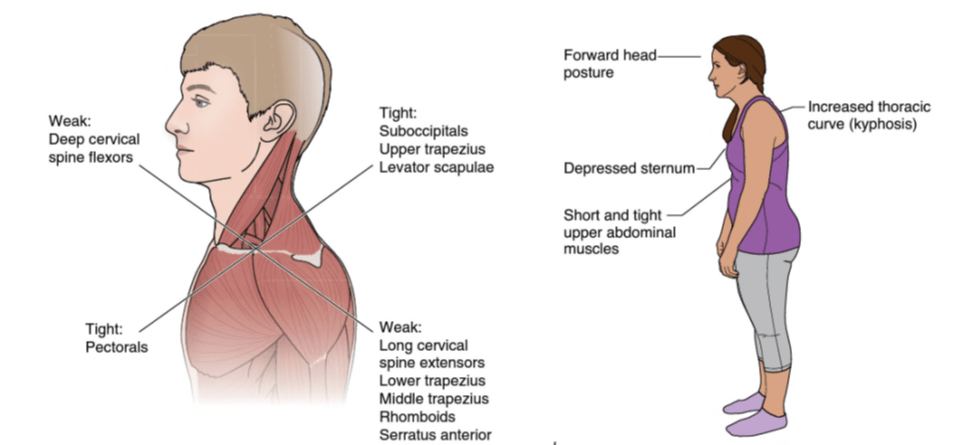
Osteopathic Framing: Structure Follows State
Osteopathic medicine has always emphasized that structure and function are inseparable. Less often stated—but equally important—is that function includes nervous‑system state.
When arousal is chronic:
- Muscle tone increases where stability is prioritized
- Motion decreases where uncertainty feels unsafe
- Breathing shifts toward the upper chest
- Fine motor control gives way to bracing
Over time, joints adapt to this pattern. Muscles lengthen or shorten accordingly. Upper Crossed Syndrome becomes visible—but it did not start as a “postural problem.”
It started as an adaptive state.
Why UCS Persists in Chronic Pain
Chronic pain conditions frequently coexist with UCS because both involve reduced variability. The body loses its ability to shift easily between effort and rest, tension and release, extension and flexion.
Attempts to “fix posture” without addressing this underlying rigidity often fail. Forcing the shoulders back or the head upright can increase discomfort or fatigue because the nervous system senses threat rather than support.
The lesson is simple but often overlooked:
the body must feel safe to change how it holds itself.
Addiction, Arousal, and Upper Body Tension
In the context of addiction, UCS takes on additional meaning. Many substances and behaviors temporarily change muscle tone, breathing, or perception of effort—providing relief from persistent tension.
From this lens, addiction and posture are not separate problems. They are both attempts to regulate internal state. When the system loses internal flexibility, it looks outward for help.
Restoring bodily options reduces the need for compensations—whether chemical, behavioral, or postural.
Unlearning UCS: A Gentle Approach
Unlearning Upper Crossed Syndrome is less about correction and more about restoration of choice.
1. Start With Safety, Not Alignment
Before posture can change, down‑regulation is necessary. Slow breathing, quiet environments, and movements that feel easy signal the nervous system that exploration is allowed.
2. Restore Motion Before Position
Gentle thoracic movement, rib expansion, and soft cervical motion reintroduce variability. Think motion within comfort, not stretching to extremes.
3. Reduce Effort in the Neck and Shoulders
Many people unknowingly hold their shoulders up all day. Practicing brief periods of letting them drop—especially during exhalation—helps interrupt automatic tone.
4. Retrain Support, Slowly
Deep neck flexors and lower scapular muscles respond best to low‑load, slow exercises. Small, precise movements retrain coordination without provoking bracing.
5. Integrate Awareness, Not Vigilance
Somatic approaches emphasize noticing without fixing. Simply observing posture shifts during stress, conversation, or screen use builds awareness without judgment.
This is how habits unwind—quietly.
Consciousness and Change
What makes Upper Crossed Syndrome particularly relevant to your thesis is that it is not solved through instruction alone. It changes when implicit memory is given new experience.
This is where osteopathic care, somatic therapy, breathwork, and even psychedelic integration converge. Each creates conditions for the nervous system to safely experience alternatives—new relationships between effort and ease.
Consciousness does not overpower habit.
It creates space around it.
Closing Reflection
Upper Crossed Syndrome is not a failure of discipline or strength.
It is the residue of adaptation.
When the body learns that it no longer needs to brace, posture follows naturally. Shoulders drop. Breath deepens. The head floats back—not because it was told to, but because it can.
Healing in this context is not about “standing up straight.”
It is about remembering how to move—and rest—again.
That is where chronic pain eases.
That is where trauma loosens its grip.
That is where new choices become possible.

