
Gordon Zink and the Common Fascial Compensation Patterns
Gordon J. Zink, DO (1913–1994), a Nobel-trained osteopathic physician from Pennsylvania who practiced in Iowa, developed a foundational model of fascial compensation that remains essential in biomechanical reasoning. Rather than mistake compensatory changes for pathology, Zink recognized them as intelligent adaptations—especially important when working with patients affected by chronic pain and trauma.
Zink’s Four Key Transitional Zones
Zink identified four spinal junctions—where movement tends to change direction and fascial compensation commonly occurs:
- Occipito-atlantal (OA) – head‑to‑neck
- Cervicothoracic (CT) – neck‑to‑upper back
- Thoracolumbar (TL) – middle back‑to‑low back
- Lumbosacral (LS) – low back‑to‑pelvis/sacrum
At these transitional zones, the body often adapts with predictable fascial rotational biases.
The Common Compensatory Pattern (CCP)
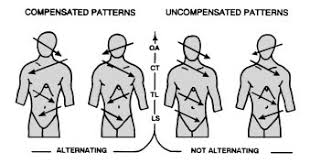
In approximately 80% of healthy individuals, these fascial rotations alternate predictably:
- OA: Left
- CT: Right
- TL: Left
- LS: Right
This L/R/L/R sequence supports resilient adaptation by distributing fascial load efficiently across segments.
Why That Matters
- Compensated pattern (alternating): Indicates the body is adapting across segments—typically seen in healthy or balanced systems. Zink noted these individuals often tolerate stress and recover more quickly.
- Uncompensated pattern (non-alternating): e.g., L/L/R/L. This is less efficient, leading to higher fascial strain and poorer fluid/dynamic balance. It’s commonly seen after trauma, chronic illness, or prolonged stress.
Fascial Compensation and Systemic Impact
Zink proposed that fascial bias not only affects motion but also influences lymphatic and venous drainage, since fascial sheaths house these vessels. If fascia fails to glide properly, fluid stasis can set in, contributing to pain, inflammation, and slowed recovery.
Chronic Pain
Persistent fascial restrictions in an uncompensated pattern can drive steady nociceptive input. The body remains in low-level inflammatory or pain states even when tissue injury has healed.
Trauma
Traumatic events—physical or emotional—can disrupt fascial compensation patterns, shifting them from compensated to uncompensated. Zink’s model explains why postures and aches emerge in response to deep emotional or structural stress.
Practical Takeaways
- Assess the pattern – Use palpation or movement screens to check for OA→CT→TL→LS alternation.
- Restore fascial glide – Begin with gentle, global techniques (myofascial release, balanced diaphragm action, cranial-sacral work).
- Re-establish compensation – Encourage the full L/R/L/R pattern before targeting segmental issues.
- Integrate regulation – Combine fascial work with breath training, trauma-informed touch, and somatic awareness.
- Advance gradually – Only then layer in strengthening or targeted modalities—ensuring the pattern remains compensated and adaptable.
Further Reading
- Zink, J. G. Collected Works of J. Gordon Zink, DO. late 1990s.
 Conscious Osteopathy