
Who created osteopathy?
The traditional answer is clear: Andrew Taylor Still (1828–1917) founded osteopathy in 1874 and established the American School of Osteopathy in Kirksville, Missouri, in 1892.
Both statements are true.
The fuller story, however, is more complex. Osteopathy emerged from Still’s study of anatomy, frontier medical practice, personal loss, Civil War-era medicine, and his experiences among the Shawnee people in Kansas Territory. To understand osteopathy’s origins honestly, we should acknowledge each of these influences.
The Shawnee Mission Years
In 1853, 25-year-old Andrew Taylor Still joined his father, Abram Still, at the Wakarusa Shawnee Mission in Kansas Territory. His father was a physician and Methodist minister. Still continued his medical apprenticeship there and participated in caring for Shawnee patients affected by cholera, pneumonia, fever, erysipelas, and other illnesses common on the frontier.
During this time, Still lived among or near the Shawnee community, learned the Shawnee language, practiced alongside his father, and encountered Indigenous approaches to illness and injury. Later accounts describe an exchange of knowledge that developed over time between the Still family and Indigenous communities.
This period matters because osteopathic medicine would eventually emphasize whole-person care, the interrelationship of body systems, and the body’s capacity for self-regulation and recovery.
Still’s time in Kansas Territory also occurred within a much larger history of displacement, land loss, mission influence, and political violence. Indigenous communities were not merely a backdrop to a physician’s personal development. They possessed established knowledge systems, cultural practices, and healing traditions of their own.
The Shawnee World Around Still
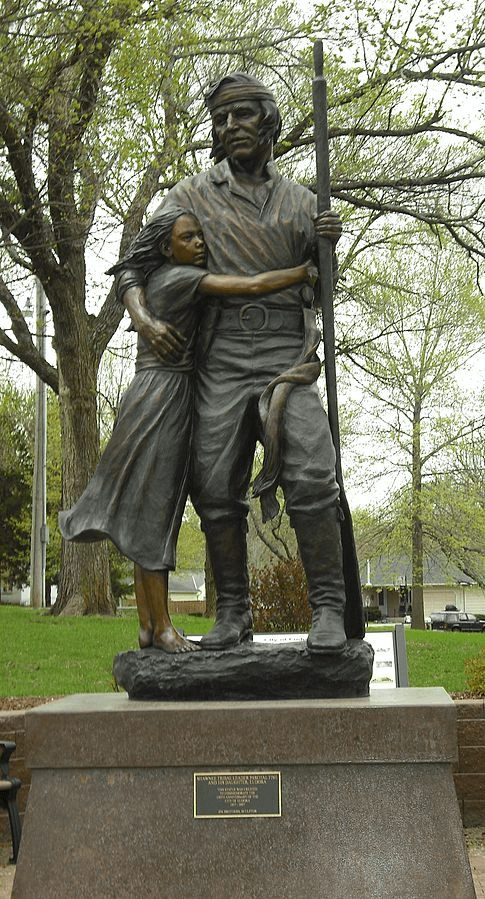
One important figure in the region was Paschal, or Pascal, Fish, a Shawnee leader, entrepreneur, landowner, and later chief of the Shawnee Nation. Fish lived near the Wakarusa settlement and was influential in the history of eastern Kansas, including the area that later became Eudora.
There is no evidence that Fish directly taught osteopathy to Still. But that is not the central point.
The Shawnee were Still’s neighbors, patients, interpreters, teachers, and fellow inhabitants of a rapidly changing frontier. Their presence and worldview formed part of the environment in which the young physician developed his understanding of health, illness, and healing.
The Story of the Injured Leg
A frequently repeated story in osteopathic history describes Still witnessing Indigenous treatment of a severe lower-extremity injury. In some versions, an injured limb was tied by rope to a horse and traction was applied to restore alignment.
The documentation for a single horse-and-rope event is limited, and the details vary across retellings. It is best understood as a possible influence rather than as the definitive origin story of osteopathic manipulation.
The larger lesson is more credible and more important: Still spent years observing practical methods intended to restore function in settings with limited equipment, pharmaceuticals, and surgery. He also developed firsthand experience with manual correction. During his time at the Shawnee Mission, he described reducing hip dislocations associated with severe cholera spasms so that bodies could be prepared for burial.
These experiences reinforced a simple clinical observation:
When structure changes, function may change.
That observation later became central to osteopathic thinking, although it was refined through Still’s study of anatomy, clinical practice, philosophical work, and decades of experience—not through one dramatic event.
What Recent Scholarship Adds
Recent scholarship has made a stronger case for recognizing Indigenous influence in the history of osteopathic philosophy and manual medicine.
In Indigenous Roots of Osteopathy, Mehl-Madrona, Conte, and Mainguy compare Indigenous manual-healing practices with osteopathic manipulative approaches. They identify similarities including work intended to support breathing and respiratory function, stretching and traction of limbs, kneading or wringing of muscles, and hands-on approaches involving the skull, head, and neck.
These similarities do not prove that specific osteopathic techniques were directly adopted from Shawnee healers. Historical influence is rarely linear or easily attributed to one person or one event. Still was also influenced by frontier bone-setting, medical apprenticeship, anatomy, religious and philosophical thought, and dissatisfaction with the treatments of his era.
Still, the comparison supports a more complete historical understanding: Indigenous knowledge and healing traditions may have contributed to the intellectual and clinical environment in which Still formed his ideas about structure, healing, and the physician’s hands. Rocky Vista University likewise notes that Still’s engagement with Native American communities may have influenced both the body-mind-spirit framework in osteopathic medicine and the development of osteopathic manipulative treatment.
Recognition Without Appropriation
This history should be discussed carefully.
There is no single Indigenous healing tradition. Native nations are diverse, and their cultural practices, beliefs, and medical traditions cannot be collapsed into one generalized concept. Similarly, whole-person care, manual healing, and attention to the relationship between people and their environment are not exclusive to any one tradition.
Still, acknowledging likely Indigenous influence is different from claiming that osteopathy is Indigenous medicine.
A more responsible framing recognizes that Still encountered Indigenous communities with sophisticated, living systems of knowledge. His experiences among the Shawnee may have broadened his understanding of health as connected to the body, mind, spirit, community, and environment.
An Ethical Reckoning
A full account must also include harm.
In his autobiography, Still described disturbing Native American graves and disinterring bodies in pursuit of anatomical knowledge. These acts were harmful and occurred within a broader history of scientific and institutional exploitation of Indigenous peoples, lands, remains, and knowledge.
This should not be minimized. Acknowledging Indigenous influence while overlooking this harm would offer only a partial history.
For osteopathic physicians today, respect means more than recognizing historical connections. It calls for cultural humility, accurate language, avoidance of appropriation, and meaningful support for Indigenous leadership in medical education, clinical care, and research.
Still’s Search for a Different Medicine
Still’s life was also shaped by profound loss. His first wife died in 1859. In 1864, three of his children died during a meningitis epidemic. These tragedies, along with his experience practicing medicine during the Civil War era, deepened his dissatisfaction with common treatments of the time, including bleeding, purging, and mercury-containing remedies.
Rather than abandoning medicine, he sought a different approach.
He immersed himself in anatomy and studied the relationship between structure and physiologic function. He became convinced that the body had capacities for self-regulation and recovery that medicine often overlooked. In 1874, he formally announced what would become osteopathy.
A More Complete History
Andrew Taylor Still deserves recognition as the founder of osteopathy.
He also deserves to be understood accurately: as a frontier physician shaped by anatomy, hardship, changing medical practice, and years spent among the Shawnee people in Kansas Territory.
Acknowledging the probable influence of Indigenous knowledge does not diminish osteopathy. It enriches its history while reminding us that medicine’s past includes exchange and harm, insight and appropriation, progress and responsibility.
“The body is a unit.”
Osteopathy would later formalize this as a foundational principle. Long before that, Still lived in a frontier world where health was not easily separated from community, environment, culture, or the larger rhythms of life.
Further Reading
- Still, A.T. Autobiography of Andrew Taylor Still. 1897.
- Still, A.T. Philosophy of Osteopathy. 1899.
- Mehl-Madrona L, Conte JA, Mainguy B. “Indigenous Roots of Osteopathy.” AlterNative. 2023;19(4):923–932. https://www.semanticscholar.org/paper/Indigenous-roots-of-osteopathy-Mehl-Madrona-Conte/94d24f4f8912f634a660deda1d64028bd8dcb439
- Zegarra-Parodi R, Draper-Rodi J, Haxton J, Cerritelli F. “The Native American Heritage of the Body-Mind-Spirit Paradigm in Osteopathic Principles and Practices.” International Journal of Osteopathic Medicine. 2019.
- Rocky Vista University. “Celebrating Dr. A.T. Still’s Birthday and Honoring the Native American Influence on Osteopathy.” https://www.rvu.edu/blog/at-still/
- Museum of Osteopathic Medicine, A.T. Still University: materials on Dr. Still’s American Indian connections and Shawnee Mission history.

