
The VA Whole Health Circle: When Medicine Starts With “Me”
The Veterans Health Administration (VHA) developed the Whole Health Circle to answer a deceptively simple question:
What really matters to you?
Instead of starting with disease, diagnosis, or utilization metrics, the Circle of Health begins with the individual—placing “Me” at the center—and radiates outward into the many dimensions that shape health across a lifetime.
This orientation marks a meaningful shift in modern medicine and aligns closely with osteopathic principles and consciousness‑based healing.
What Is the Circle of Health?
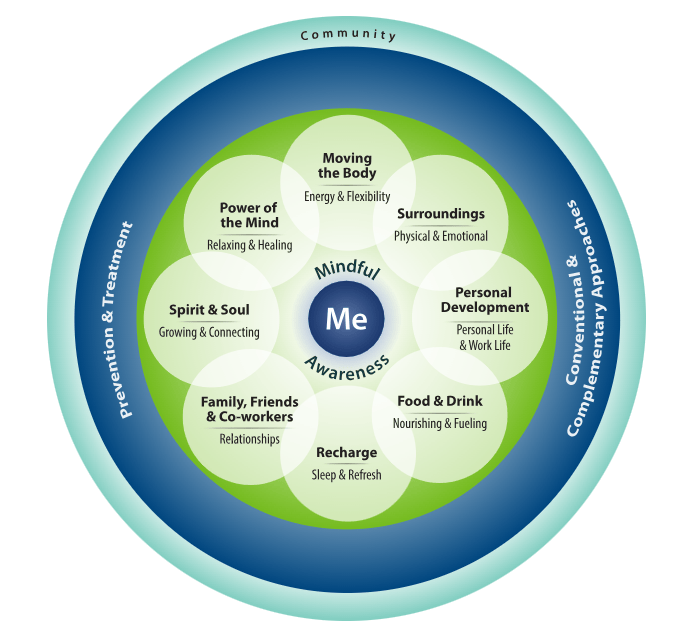
According to the VA, the Circle of Health is a tool that:
“helps you examine well‑being from many angles” by showing how different aspects of life connect to overall health.
At its core is Me—the person’s values, goals, and sense of meaning. Surrounding this center are interconnected domains including:
- Working the body (movement, physical activity)
- Surroundings (environment, safety)
- Personal development
- Food and drink
- Recharge (sleep, rest)
- Family, friends, and co‑workers
- Spirit and soul
- Power of the mind
- Professional care
The Circle does not rank these domains. Instead, it emphasizes interdependence—a concept foundational to osteopathy.
A Familiar Osteopathic Philosophy
Andrew Taylor Still asserted that the body is a unit and that health emerges when structure, function, and environment are in harmony. The VA’s Circle of Health embodies this principle operationally.
Rather than isolating symptoms, it recognizes that pain, illness, and recovery occur within lived context. Chronic pain is not treated solely with medications. Trauma is not addressed only through narratives. Addiction is not reduced to moral failure or compliance.
The Circle makes explicit what osteopathy has long implied: the person is not divisible.
Chronic Pain and the Limits of the Biomedical Model
The VA developed Whole Health partly in response to conditions that strain conventional systems—especially chronic pain. Veterans experience high rates of musculoskeletal pain, post‑traumatic stress, and long‑term medication use.
The Circle reframes pain not as an enemy to eradicate, but as a signal that multiple domains may be out of balance. Sleep disturbance, isolation, loss of purpose, environmental stressors, and unresolved trauma are all placed within view.
This resonates strongly with modern pain science and with osteopathic manipulation medicine, which seeks to restore movement, circulation, and regulation rather than suppress symptoms.
Trauma, Autonomy, and “Me at the Center”
For trauma‑affected individuals, agency matters.
By placing “Me” at the center, the Circle restores choice and autonomy, which are often eroded by traumatic experiences and institutional healthcare. Veterans are invited—not instructed—to identify their own priorities.
This shift reduces threat and supports nervous‑system regulation. Trauma‑informed care emphasizes safety, collaboration, and empowerment. The Circle of Health operationalizes those principles in a system‑wide framework.
Addiction and Reframing Motivation
Addiction and substance use disorders are deeply intertwined with pain, trauma, and loss of meaning. The Circle does not collapse addiction into a single box. Instead, it recognizes that substances often serve roles within a larger system—relating to sleep, stress, social connection, and purpose.
Whole Health encourages exploration of why behaviors exist before trying to remove them. This approach aligns with harm reduction, somatic therapies, and consciousness‑based work—not by excusing behavior, but by understanding it.
Where Osteopathic Manipulation Fits
Osteopathic manipulation medicine fits naturally within the “Working the Body” and “Professional Care” domains—but its influence reaches across the entire Circle.
Hands‑on care:
- Improves movement and circulation
- Reduces autonomic overdrive
- Enhances interoceptive awareness
- Supports regulatory capacity
When integrated within a Whole Health framework, osteopathy becomes more than physical treatment—it becomes a gateway to reconnection, supporting other domains such as sleep, emotional regulation, and re‑engagement with life.
Consciousness as a Clinical Variable
Perhaps most striking is how closely the Circle mirrors consciousness‑based models of healing. Domains like Spirit and Soul and Power of the Mind acknowledge inner experience as clinically relevant—not peripheral.
This is not mysticism. It is recognition that attention, meaning, perception, and narrative shape physiology. Chronic pain, trauma, and addiction all alter consciousness. Healing, therefore, must invite changes in awareness—not just in chemistry or mechanics.
A Cultural Turning Point
The VA is the largest integrated healthcare system in the United States. Its adoption of the Whole Health Circle signals something important: systems are beginning to catch up to wisdom that has long existed at the margins.
Osteopathy, in many ways, anticipated this shift. The Circle of Health can be seen as a modern articulation of osteopathic philosophy—translated into language institutions can use.
Closing Reflection
The Circle of Health does not replace medicine.
It restores context.
By starting with “Me,” it reminds us that healing is not something done to people, but something that emerges with them.
For those living with chronic pain, trauma, and addiction, this reframing is not symbolic—it is essential.
And for practitioners grounded in osteopathic principles, the Circle feels less like innovation and more like recognition.

